

Selena
Live chat
Your first 2 minutes are free
Tarot numerology explained: what numbers 1 through 10 mean, how number plus suit gives you any card, and how to spot number patterns in a spread.
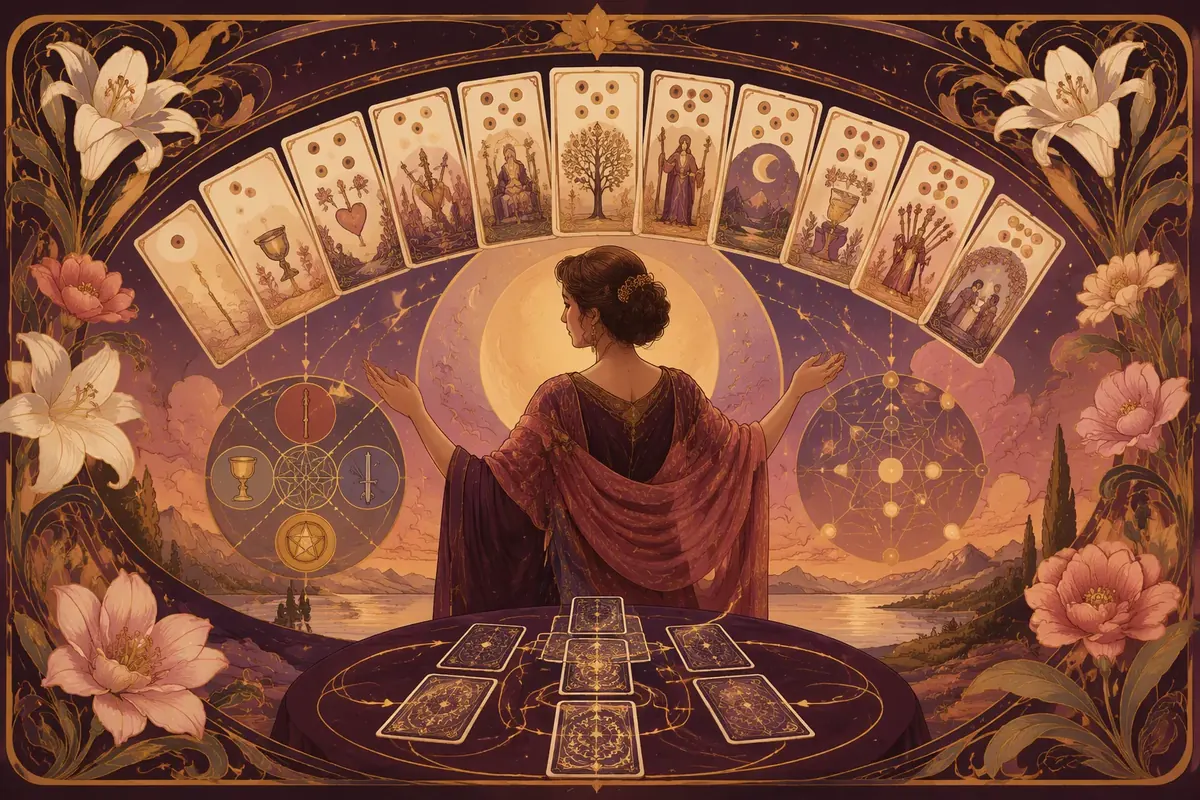
In tarot, every number carries its own meaning: Aces are beginnings, Fives are conflict, Tens are completion. Learn the arc from one to ten and you can work out any Minor Arcana card by combining its number with its suit, instead of memorizing forty separate meanings.
This is the single biggest shortcut I give beginners, and I wish someone had given it to me earlier. I spent my first year with flashcards, grinding keywords, before I noticed the deck had been showing me one repeating pattern the whole time. It is one story told in four languages, which beats memorizing 78 separate meanings.
The numbered cards of each suit walk the same road from seed to harvest. Here is the arc:
Fours settle, Fives break, Sixes repair. That sequence holds across all four suits, and once you hear it you start noticing it in every spread.
The number tells you the stage. The suit tells you the arena. Blend them and you have the card.
Take the Fives, since conflict is where people panic in readings. Same core theme, four different battlefields:
This formula is also your safety net mid-reading. A client asks about her job, you flip the Seven of Pentacles, and your mind goes blank. Seven means assessment, Pentacles means material life, so the card is about pausing to evaluate whether the work is paying off. You just reasoned your way to the card. That is a legitimate way to read, and it produces better interpretations than recited keywords, because you built the meaning for this question. It is the same logic that rescues you with decks that have no pictures on the pips, which I cover in how to read pip cards without scenic imagery.
The Majors run from the Fool at zero to the World at 21, and they read as their own numbered sequence. Low numbers deal with foundations and the self. The middle stretch is challenge and transformation. The high numbers are awakening and completion. Knowing where a Major sits in that progression, often called the Fool's journey, tells you how deep in the arc of growth a situation is, which is a different kind of information than any single keyword. If the difference between the two halves of the deck is still fuzzy, start with Major versus Minor Arcana and come back; the numbers will make more sense with that frame in place.
Numerology also uses reduction, adding the digits of a bigger number to reach a single digit. The Tower is 16, and one plus six is seven, which links it quietly to the reflective, unsettling quality of the Sevens. The Star is 17, reducing to eight: movement and focus after the upheaval.
Reduction is a garnish, not the meal. I use it maybe one reading in twenty, when a Major feels opaque and I want another thread to pull. If it illuminates something, wonderful. If it starts feeling like math homework, drop it. Nothing about your reading depends on it.
Before you interpret anything, run your eyes across the numbers on the table. It takes five seconds.
Mostly low numbers means the situation is early, still forming, and any prediction should be held loosely. A cluster of Nines and Tens puts you near an ending or a turning point, whether the person asking is ready to admit it or not. Three cards of the same number and that theme is shouting. A woman I read for pulled three different Twos in one relationship spread, and we did not need anything fancy: her entire situation was a choice she kept refusing to make, and every suit was saying so at once.
This number scan is part of the larger skill of reading cards against each other rather than one at a time, which I break down in how tarot cards talk to each other. And if you are curious what numerology says about you rather than your cards, drawn from your own birth data, that is its own kind of reading: my Personal Year reading maps which stage of the one-to-nine cycle your life is in right now.
Use them to learn faster, to reason through cards that go blank on you, and to take the temperature of a whole spread at a glance. Then let the image, your instinct, and the story of the reading have the final word.
Each number from one to ten carries a stage of a cycle: Aces begin, Twos balance and choose, Threes grow, Fours stabilize, Fives disrupt, Sixes recover, Sevens assess, Eights push forward, Nines intensify, and Tens complete. Combine the number's stage with the suit's area of life, and you have the essential meaning of any Minor Arcana card.
Numerology gives tarot its underlying structure. Readers use the one-to-ten arc to interpret the Minor Arcana, the zero-to-21 sequence to place Major Arcana cards along the Fool's journey, and digit reduction to connect larger numbers to single digits. It works as a reasoning tool: when you forget a card's keywords, number plus suit rebuilds the meaning logically.
Repeated numbers amplify that number's theme and deserve attention before individual card meanings. Several Twos point to a decision or a partnership dynamic dominating the situation. Multiple Fives signal widespread conflict or loss. Repeated Tens mark a major chapter closing. The repetition tells you the theme is active across several areas of life at once.
No, but it dramatically shortens the learning curve. You can read tarot purely from imagery and intuition. Knowing the number meanings means you never face a blank: any numbered card can be worked out from its stage and suit. Most experienced readers use numerology as quiet scaffolding underneath a reading rather than as a separate system.
Free love reading
Want the honest read on your situation?
Articles can only speak in general. I'll pull the cards for your question and send your reading by email. No payment, no account. Just the truth, gently.
Get my free reading →4,600+ readings delivered · normally $29, free today
Prefer a full private reading? Browse my readings
Your love questions deserve a straight answer
Get my free reading → 1