
Selena
Live chat
Your first 2 minutes are free
All 8 moon phases explained, with what to do at each one: intentions at the new moon, release at the full moon, rest at the dark. With tarot pairings.
 The Moon: the full card meaning
Upright, reversed, in love, as feelings and in career, on its own page.
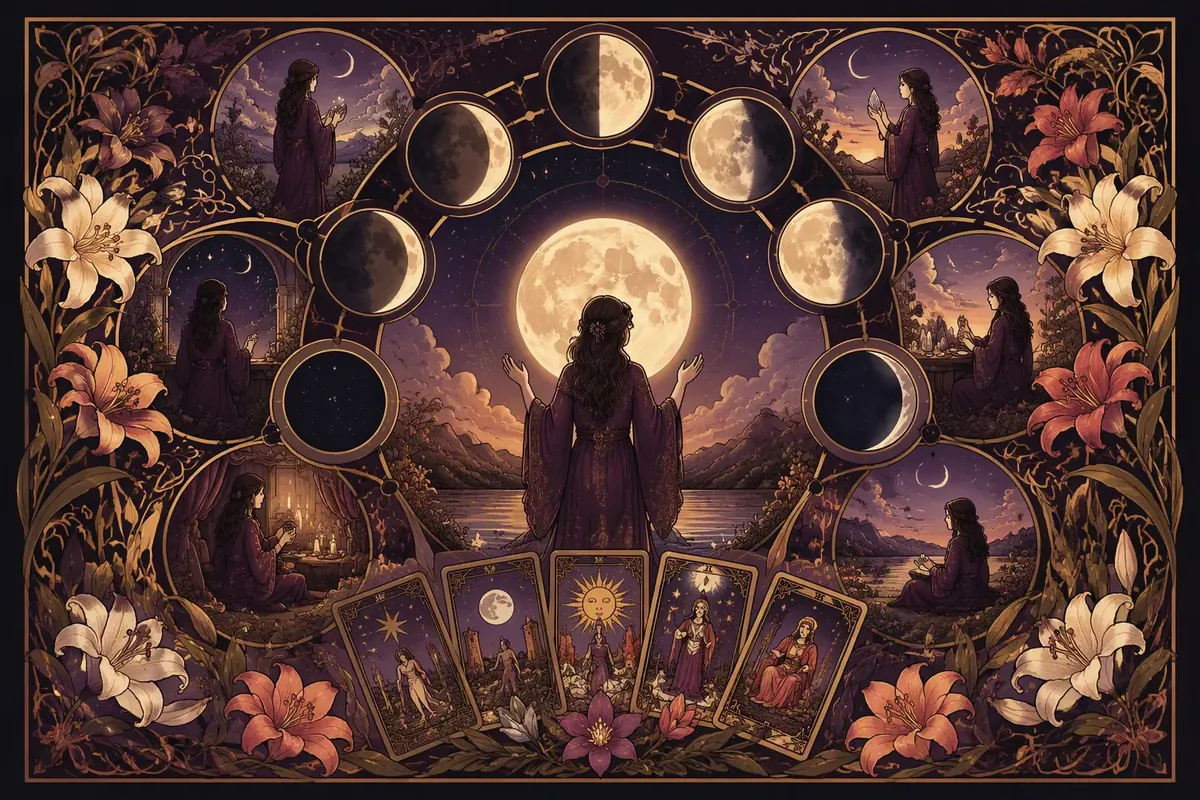
The moon cycles through eight phases in about 29.5 days, and each phase favors a different kind of work: the new moon is for setting intentions, the waxing half is for building, the full moon is for clarity and release, and the waning half is for letting go and resting. Everything else is detail.
I've kept a moon practice alongside my tarot practice for years, and I'll tell you up front what I tell clients: you don't need to believe the moon controls anything to get value from this. A recurring rhythm of begin, build, release, rest is something modern life refuses to give you. The moon hands it to you every month for free.
Before the eight phases, learn the shape. The first half of the cycle, from dark to full, is the light growing: energy rising, things taking form. The second half, full back to dark, is the light receding: finishing, shedding, slowing down.
Most women I read for live as if every week should be a waxing week. Push, produce, improve, repeat. Then they hit the natural waning stretch of their own energy and read it as failure. Half of every cycle is designed for release and rest. The moon is the only calendar honest about that.
The sky is dark, the cycle resets. This is the moment for naming what you want to grow in the next month. Two or three intentions, written down, is plenty. I keep a whole practice around this, which I've laid out in my guide to new moon rituals. One warning: don't expect to feel energized at the new moon. It's often the lowest-energy point of the month. Plant quietly and go to bed.
The first sliver of light. Take one small action toward each intention. Send the message, book the class, open the document. Momentum is built here, in moves so small they feel almost embarrassing.
Half lit, and this is where the early resistance shows up: doubt, inconvenience, the old habit pulling you back. The first quarter is decision energy. You recommit or you quietly drop the intention. Both are allowed; drifting is what costs you.
Almost full. The work is adjustment now, not launching. Trim what isn't working, stay with what is. Patience lives here, and it's the phase impatient people (hello) find hardest.
Peak light. Whatever has been building, in your projects and in your heart, comes to a head and becomes visible. Celebrate what grew. Then name what you're ready to put down, because release work lands hardest at the full moon. I use a specific five-card layout for this, the full moon release spread, and it's the single moon practice I'd keep if I had to drop all the others.
The light starts receding. Traditional lore calls this the gratitude phase: share what you learned, thank who helped, look at what the full moon showed you without flinching.
Half lit again, on the way down. Letting-go work: forgiveness, unsubscribing, ending what's over. If the full moon showed you a truth, the last quarter is when you act on it.
Almost dark. Surrender, closure, sleep. Do less on purpose. The seed you'll plant at the next new moon is forming now, in the quiet, whether you notice or not.
You do not need eight rituals a month. Nobody sustains that. Here's the version my clients actually keep:
A moon journal makes this compound. One card and three lines at each new and full moon, dated. After three or four cycles you'll flip back and see your own patterns written in your own hand, which themes keep returning, which intentions you keep planting and abandoning at first quarter. That record will teach you more about yourself than any single reading I could do for you. If you want the exact dates for the year ahead, my moon calendar lists every new moon, full moon, and eclipse with a question to ask the cards at each one.
Honest answer: I don't know, and I've stopped caring, because the practical result is the same either way. Many women I read for report feeling wired and social around the full moon and inward and tired near the new moon. Whether that's lunar influence or the power of paying attention, you can use it.
Track your own energy across two cycles before assuming the standard pattern fits you. Some people run opposite to the textbook: flat at the full moon, sparking with ideas at the dark. Your rhythm is the one that counts. The goal was never to obey the moon; it was to stop treating all thirty days as if they should feel identical.
The deck and the moon are old companions. The High Priestess sits with the crescent moon at her feet, keeper of the knowing that only surfaces in quiet, and she's the energy of the dark phases. The Moon card itself speaks to the fog of the in-between, when you can't yet see what's forming. Pulling cards at the new and full moon gives your intuition two standing appointments a month, and appointments are how intuition gets stronger.
New moon, waxing crescent, first quarter, waxing gibbous, full moon, waning gibbous, last quarter, and waning crescent. The cycle takes about 29.5 days. The four waxing phases build from darkness to full light and suit starting and growing things; the four waning phases recede back to dark and suit finishing, releasing, and resting.
Set intentions at the new moon, take first steps during the waxing crescent, push through resistance at the first quarter, and refine during the waxing gibbous. At the full moon, celebrate what came to light and name what to release. Then share and reflect during the waning gibbous, let go at the last quarter, and rest during the waning crescent.
The full moon marks the peak of the cycle, when what has been building becomes fully visible. In practice, that visibility is the point: most things we need to release are things we've half admitted to ourselves, and the full moon works as a monthly deadline to make the letting-go official through journaling, ritual, or a short tarot spread.
Evidence is mixed, but many people consistently notice feeling more outgoing and restless near the full moon and more tired and inward near the new moon. Whether that comes from the moon itself or simply from paying attention, tracking your energy across two full cycles reveals your personal rhythm, and planning around that rhythm is what makes the practice useful.
Free love reading
Want the honest read on your situation?
Articles can only speak in general. I'll pull the cards for your question and send your reading by email. No payment, no account. Just the truth, gently.
Get my free reading →4,600+ readings delivered · normally $29, free today
Prefer a full private reading? Browse my readings
Your love questions deserve a straight answer
Get my free reading → 1