


Selena
Live chat
Your first 2 minutes are free
How to choose your first tarot deck without freezing up: why scenic imagery matters most, what to check before buying, and the gift myth to ignore.
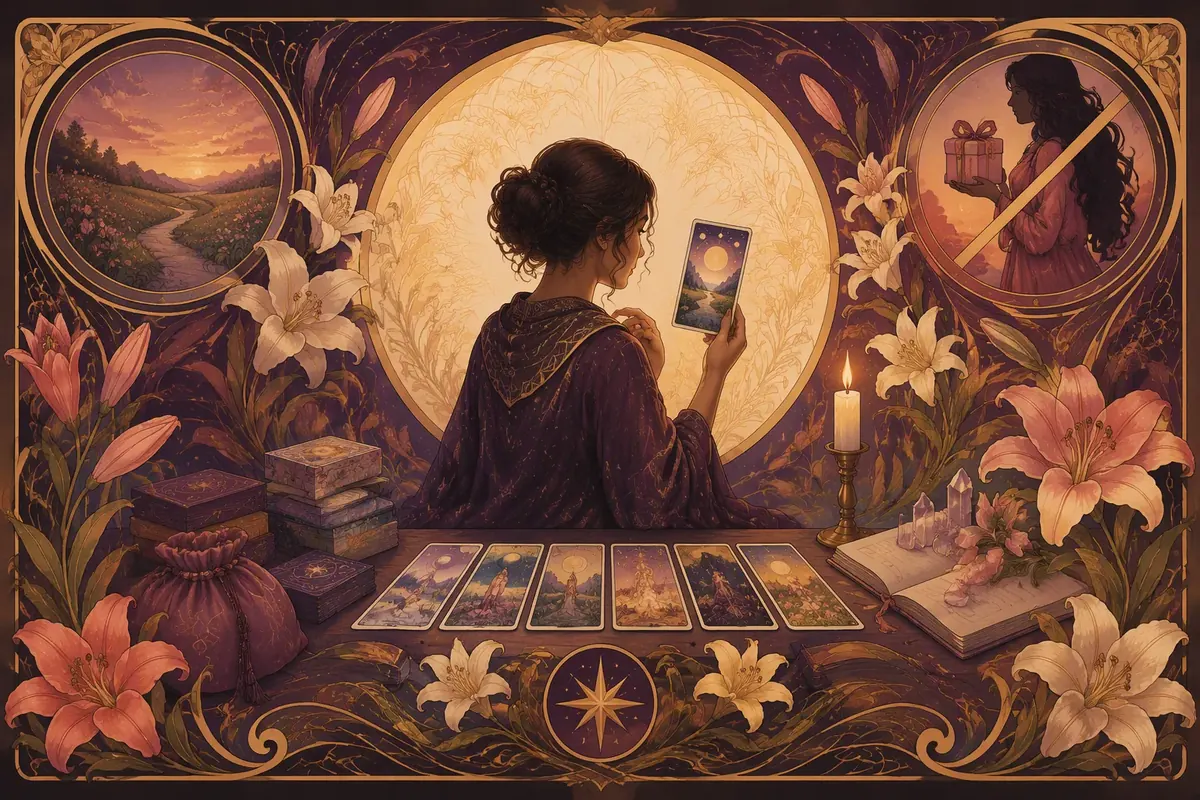
Choose a first tarot deck with three things: 78 fully illustrated cards in the Rider Waite Smith tradition, art you genuinely love looking at, and a guidebook in the box. That combination covers ninety percent of what matters. Everything else, including the superstition that someone must gift you the deck, is noise.
I say this as someone who owns more decks than I will admit in print, and who still reaches for a battered RWS-style deck when a reading really matters.
Your first deck needs a full scene on every card, including the number cards. This is the opinion I hold most firmly here, after watching it play out with student after student.
In the Rider Waite Smith tradition, the Five of Cups shows a figure in a black cloak grieving over three spilled cups while two full ones wait behind him. You can read that story off the picture before you have memorized a single keyword.
Many gorgeous indie decks use plain pip cards instead: just five cups, arranged prettily, meaning nothing to your eye yet. Those decks are wonderful later. I use them myself, and I even wrote a guide to reading pip cards without scenic imagery. But handing one to a beginner is like teaching someone to read with a book that has no pictures and half the letters missing. You will spend your first year flipping to the booklet for every single card, and most people quit somewhere in that year.
You do not need the original 1909 artwork, which some people find dated. Hundreds of modern decks keep the RWS structure with fresh art. The phrases to look for in a listing: "RWS based," "Rider Waite Smith tradition," or "78 cards, fully illustrated."
Within that tradition, pick the art that pulls you in. You are going to look at these images thousands of times, and a deck you find beautiful is a deck you actually reach for on a tired Tuesday night. A deck you bought because a list said it was correct will sit in the drawer.
When a student tells me she keeps "forgetting" to practice, my first question is always whether she likes her deck. The answer is almost always no.
While your eye is choosing, let your hands have a vote too:
Get a deck that comes with a real companion book, not just a folded slip of paper with one keyword per card. In your early months, that book is a steady hand, telling you what the creator intended and giving you somewhere to start when a card feels mute.
Two cautions, though. First, the booklet is a reference, not scripture. When your gut says a card means something different in this spread, your gut gets a seat at the table. Second, plan to outgrow it. If you are still looking up every card after a year, the problem is usually a pip deck or a practice that never got daily. My guide to building a daily tarot practice is built for exactly that transition.
Someone will tell you, possibly in a very confident tone, that a true reader never buys her own deck: it must be gifted or the cards will not work. I want to retire this myth personally.
It is a charming piece of folklore with nothing underneath it. I bought my first deck myself, with my own money, and choosing it was part of the bond. Waiting passively for someone to hand you the right deck is the exact opposite of the energy you want to start a practice with. Tarot is full of these inherited rumors, and I debunked the worst of them in my tarot myths piece. Buy your own deck. Today, if you like.
When the box arrives, resist the urge to do a huge dramatic reading in the first hour. Spend the first week just getting acquainted:
Almost every reader ends up with a small collection, each deck suited to a different mood or question. So release the pressure of choosing perfectly. You are hiring your first teacher, and the job description is short: clear illustrated scenes, art you love, a guidebook, decent card stock.
And if you want to feel what a reading sounds like while your deck is still in the mail, you can get a free three-card reading from me and study how the cards get woven into one answer.
A deck in the Rider Waite Smith tradition, meaning 78 cards where every card shows a full illustrated scene. The classic RWS deck works, but so do the many modern decks based on its structure. Scenic imagery lets you read the story from the picture while you learn, which dramatically shortens the learning curve.
No. The idea that a first deck must be gifted is folklore with no substance, and most professional readers bought their first decks themselves. Choosing your own deck often builds a stronger connection, because the deck reflects your taste from day one. Do not postpone starting a practice while waiting for someone to gift you cards.
A standard tarot deck has 78 cards: 22 Major Arcana and 56 Minor Arcana divided into four suits. Some art decks and oracle decks contain fewer, but they are different tools. For learning traditional tarot, make sure the listing specifies all 78 cards, fully illustrated, so standard books and guides apply to what you own.
Spend the first week getting familiar before doing serious readings. Look through all 78 cards in order, sort them by Major Arcana and suit to learn the structure, shuffle thoroughly to break in the cards, and pull one card daily just to observe it. Familiarity built this way gives your intuition material to work with later.
Free love reading
Want the honest read on your situation?
Articles can only speak in general. I'll pull the cards for your question and send your reading by email. No payment, no account. Just the truth, gently.
Get my free reading →4,600+ readings delivered · normally $29, free today
Prefer a full private reading? Browse my readings
Your love questions deserve a straight answer
Get my free reading → 1